Seven Coding Agents, One Space Invaders Clone

On June 15, the Claude subscription I’ve been using for unattended coding work splits into two. I can keep using the chatbot at the same cost, typing to it on the keyboard interactively. I can’t keep using Claude Code as a background worker, embedded using claude -p into broader automated workflows — the unattended operation billing moves to its own tier, and the math on running it the way I’ve been running it stops working for me.
That deadline is less than four weeks out, and it’s forcing me to examine practices I’ve been letting run on autopilot. I have a small fleet of long-running engineering tasks that have been quietly handled by Claude Code via hopper and foundry — plan, execute, validate, commit, move on. I need to know which other coding agents and which other model families can hold up the same kind of work. Not in principle. In practice. On real Rust or Elixir against real modern frameworks. For this testing, I picked Rust and Bevy, because Bevy has drifted a lot over the years and it wouldn’t be sitting comfortably in any model’s training data.
There’s a second motivation tied to the first. I’ve been wanting to figure out where local models can usefully sit in real engineering workflows — not as a hobbyist exercise, but as a serious component of how I get work done. Local means zero marginal cost, full privacy, and no exposure to someone else’s billing change. It also means I’m responsible for every layer the cloud providers were quietly absorbing for me. This bake-off is a chance to test both questions on the same task.
So I ran this test today. Same prompt — build an authentic Space Invaders clone in Rust + Bevy, from an empty repo, autonomously, through hopper’s standard phases. Seven profiles. Six model families across two runners (claude and opencode). I committed to playing every binary that compiled. This is the first writeup in what’s going to be a longer series along this journey.
Here’s today’s cohort and the result, as a single picture before I dig in:
| Profile | Runner | Models | Cost | Playable game? |
|---|---|---|---|---|
| anthropic | claude | Opus 4.7 (plan/validate), Sonnet 4.6 (execute) | $5.91 | ✓ |
| glm | opencode | Z.AI GLM-5.1 (all phases, via OpenRouter) | $2.36 | ✓ |
| openai | opencode | GPT-5.5 (plan/validate), GPT-5.4 (execute) | $0¹ | ✓ |
| qwen | opencode | Qwen3.6 Max Preview / Plus / Flash (OpenRouter) | $1.81 | ✗ crashes at launch |
| qwen-coding | opencode | Qwen3.6 27B / 35B-A3B (OpenRouter) | $1.24 | ✗ crashes at launch |
| ollama (run 1) | opencode | Qwen3.6 27b-coding / 35b-a3b (local) | $0² | ✗ no code shipped |
| ollama (run 2) | opencode | Qwen3.6 27b-coding / 35b-a3b (local) | $0² | ✗ crashes at launch |
¹ Routed via OAuth subscription, which reports zero in the audit stream — real token consumption was substantial. ² Local hosting on an M4 Max, no marginal API cost; roughly 2.5–3 hours of GPU time per run.
What I Was Actually Measuring
The headline number everyone wants is cost. I’ll get there. But cost was never the only question, and it turned out not to be the most interesting one.
What I really wanted to know:
- Can the agent loop finish unattended? No babysitting, no human nudge.
- Does “validate passed” actually mean the artefact works, or does it mean “the gates the agent chose to run said yes”?
- Where does the model fall down — at the planning layer, the execution layer, or the protocol layer between the model and the harness?
Modern frontier models have received tremendous amounts of fine-tuning towards accurate and long chains of tool use. Towards engineering practices. What do I need to add to the harnessing to compensate to models that haven’t had the same degree of this? Is it even possible?
Compile-Green Is Not Done
All profiles but one produced compilable code. Real Rust code, syntactically and seemingly structurally correct.
Three of the seven profiles produced authentic, playable Space Invaders: anthropic (Claude Opus 4.7 / Sonnet 4.6), glm (Z.AI GLM-5.1 via opencode), and openai (GPT-5.4/5.5 via opencode). I hand-played each one. Marching aliens, speed-up, bunkers eroding cell by cell, the UFO mystery ship, lives and high score, R to restart. Gameplay virtually indistinguishable across the three.
Four profiles produced binaries that crash on launch. Both qwen runs through OpenRouter, both ollama runs locally — every member of the Qwen3.6 family, across the full size range from the 27B coding tune to the ~1T frontier Max Preview, across two completely different hosting setups. All of them passed cargo build --release. None of them ran.
The crashes group into two well-known Bevy gotchas, both runtime-only. B0001, where two ECS systems want overlapping mutable access to the same component and Bevy panics at schedule start. And the missing-StatesPlugin trap, where you call init_state before DefaultPlugins and the state-transition schedule isn’t registered yet. Both are catchable in under five seconds with a smoke launch — start the binary, sleep three, kill it, check the exit. The only profile that did this as part of validate was anthropic. Everyone else trusted compile-success as a proxy for “it works.”
It’s not just about the validation contract, though. The contract helps — but the gates you wire into it, and the codebase that has to clear them, are two halves of the same question. The other half is whether what comes out is maintainable: by a human, or by the next Gen AI session that has to live in it.
And ultimately, success is the qualitative experience of playing Space Invaders. Any game designer will tell you the same thing: the game works — but is it fun?
The Cost Spread, and What It Doesn’t Buy
Among the three working profiles, the cost spread is roughly six-to-one. Anthropic ran $5.91 for the full plan-execute-validate cycle. GLM ran $2.36 (after fixing a hopper bug that was silently dropping the execute-phase cost — an unrelated win the bake-off shook loose). OpenAI shows $0 in the table, and that number is unfair to every other row. I ran it over an OAuth flat-rate subscription, so my marginal cost was zero, but the real token consumption was substantial — and a fair side-by-side needs OpenAI running across the API with per-token billing, the same shape of meter the other rows are measured on. That’s a comparison I’ll run in a future post; until then, treat the $0 as a billing artifact, not a price.
Here’s what “the full plan-execute-validate cycle” actually looks like for the anthropic profile — which model gets invoked at which phase, and which step is the harness doing on its own:
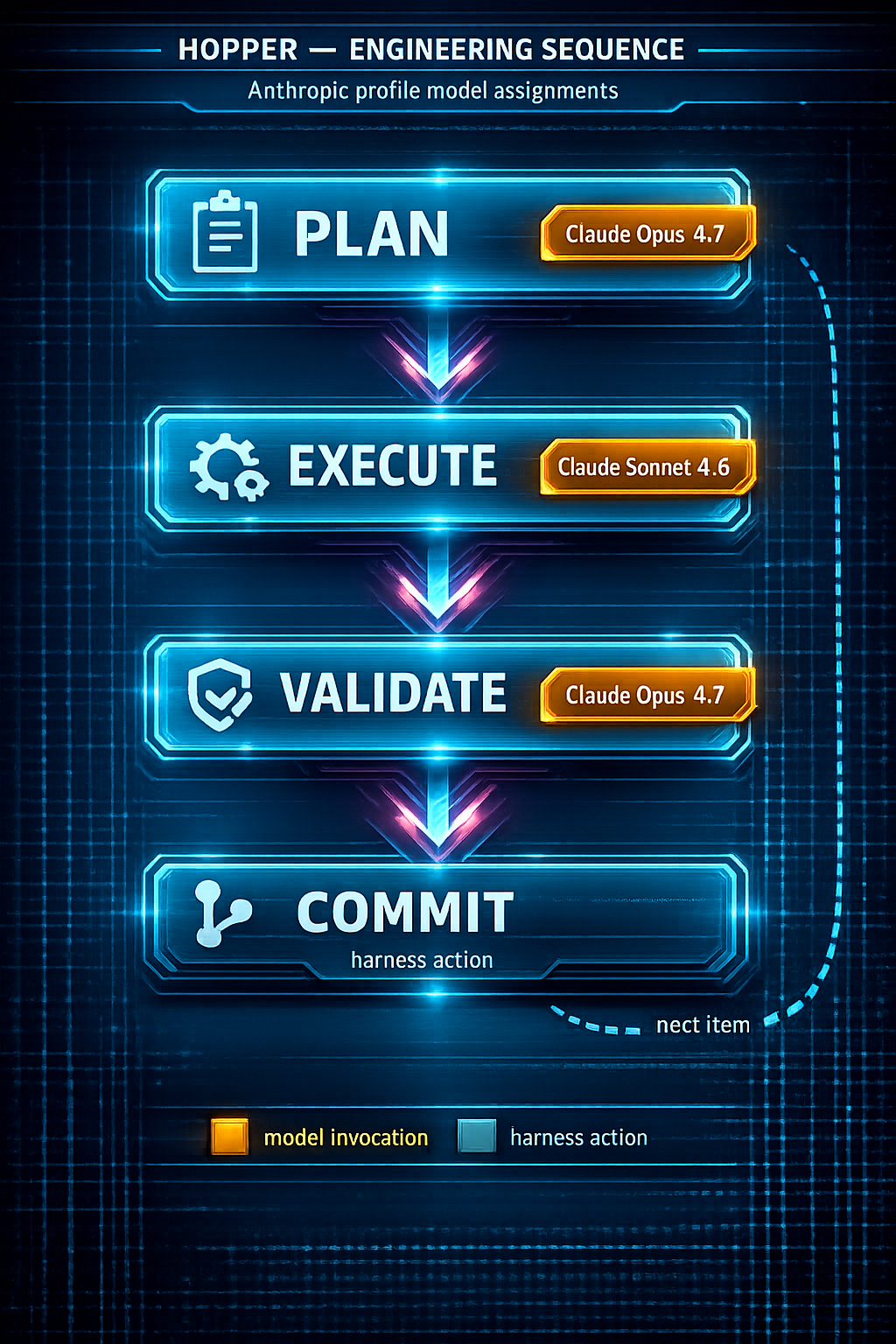
The cost premium on anthropic didn’t buy a more compelling game. It bought two things that don’t show up on the title screen. The first is defence-in-depth at the validate layer — the fmt-plus-clippy-plus-smoke-launch suite that would have caught the four qwen-family runtime crashes if the other profiles had wired it in. The second is module structure — twelve files versus nine versus one. That doesn’t change what the player sees. It changes what the next session sees when it picks the codebase up: named responsibilities, clear seams, somewhere to add the next feature without unwinding the last one.
So “GLM at $2.36 is just as good” is true on a narrow read. On this task, played once, the three working deliverables are indistinguishable in my hands. On the next task — extending the game, fixing a bug, handing the code to a different agent — the single-file shipper costs more to live with than it cost to produce. And on the axis I haven’t really measured at all — is the game fun, the way Space Invaders is supposed to be fun — I have an afternoon of hand-playing and no structured comparison. The price tag is the easiest number to put in a table. It isn’t the only one that matters.
The Layer Where Things Actually Broke
The qwen failures weren’t model-stupidity in the obvious sense. Plans were detailed. Risk registers named the right things. Code compiled. What broke was the model’s ability to reason end-to-end about Bevy’s ECS scheduler and plugin-ordering rules — the runtime invariants that live in the spaces between the code you’ve written. Every system looks fine in isolation. The conflict only shows up when they’re wired together and the schedule starts running.
The ollama local-hosting story is its own lesson. First run hung for three hours and produced nothing — the model went into a 33,000-token monologue with no tool calls, then the agent loop deadlocked. I dug into it. Root cause: ollama defaults flash attention to off. At 256K context, regular attention drifts numerically enough to corrupt the special tokens the qwen3 chat template uses to delimit tool calls from prose. The model loses its protocol mid-execute and starts generating free-form text it thinks is a tool call. After flipping OLLAMA_FLASH_ATTENTION=1 and re-running, the agent loop ran clean — though the model still shipped a binary that crashes at launch, same as its OpenRouter-hosted siblings.
Two findings stacked there. The qwen3.6 family appears to have a real ceiling on shipping runnable Rust+Bevy, independent of hosting. And local LLMs aren’t actually free — you trade dollar cost for an obligation to harden every layer the cloud providers were quietly absorbing for you.
What I’m Doing About It
This is the first post in what’ll be a series, so I’m not making a final call yet. But the direction is clearer than I expected going in.
For my unattended workload after June 15, GLM via opencode is the candidate I’m taking seriously next. The cost-and-capability fit was the bake-off’s most pleasant surprise, and I want to push it harder — find where it actually struggles, not just where it happened to succeed on a fresh-repo Bevy build. The first move there is wiring a smoke-launch gate into hopper’s default validate scaffold, because the bake-off told me the validate contract matters at least as much as the model. But that gate is the floor, not the ceiling. The harder questions are whether the codebase GLM ships at $2.36 a run is the codebase I want to live in next week, and whether the games it produces are ones I’d actually want to play. Neither of those answers comes out of the bake-off as it stands.
The local-model thread is the other one I’m not letting drop. The qwen3.6 ceiling on greenfield framework code is real, but greenfield framework code isn’t the only shape of work I do. A local model that runs cleanly through plan-execute-validate is itself useful infrastructure — the question is which workflows actually fit inside the ceiling I observed. Code review against an existing codebase. Doc generation. Refactor proposals a human verifies. Anywhere the model isn’t being asked to hold an entire architecture in its head at once. That’s a separate experiment I want to run, and I’d rather find out where local can carry real load than write it off because it stumbled on the hardest possible task I could hand it.
What I’m not going to do is treat one bake-off as the answer. Seven profiles, one task, one afternoon of hand-playing the deliverables — that’s a beginning. The interesting numbers come from running this shape of experiment enough times that the patterns start to repeat or break. I’ll keep writing them up as I go.
Compile-green is not done. Neither is gate-green. The four qwen-family runs all cleared the bar most teams would call “ready to ship,” and none of them actually were. But even among the three that played, the questions of whether the codebases were maintainable, and whether the games were fun the way Space Invaders is supposed to be fun, never made it onto the dashboard. The next time I size up an agent — or a model, or a runner — the first question I’m going to ask isn’t can it pass the gates. It’s what are the gates not measuring.